You're building a business case and you trip over an assumption you don't know. How high is the conversion rate in this segment? How much will maintenance costs go up? In the past you would have searched or asked someone. Today you ask the AI. And the AI delivers: 3 to 5 percent. You type 4 percent into your Excel cell and keep calculating.
At that moment your business case is already wrong.
That's not because the AI guessed badly. It's because 4 percent is, with near certainty, not the exact right value. It is probably somewhere close. But the chance that you hit it exactly with a single number is practically zero. You've entered precision that doesn't exist.
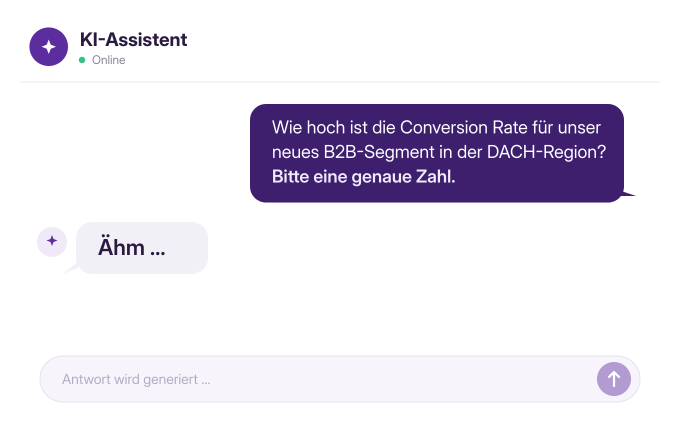
The problem goes deeper than the AI. We're trained to think in single values because Excel thinks in single values. One cell, one number. And that's exactly what we do with the AI's answer: it gives us “3 to 5 percent” and we turn it into 4. Sometimes we ask it directly for the one number, sometimes we just take the middle of the range. Either way we throw away the most valuable information in the answer: the uncertainty. This mistake existed long before AI. Business cases have always been full of single values that only look precise. The only new thing is that the AI now hands us the honest answer for free. It gives us the range. All we'd have to do is leave it there.
The right question
The range isn't a stop on the way to the number. It is the result. So leave it there, but make it as narrow as possible. Give the AI context: the industry, the business model and the specific situation. The more precise you are, the narrower the range gets. And say clearly what you want. Put it concretely: “I want a 95% confidence interval”, meaning a range in which the value lies with 95 percent probability.
The nice part: this is exactly where the AI plays to its strength. A model trained on huge amounts of data can usually mark out a range like this more narrowly and more accurately than a single person going on gut feeling. With a single value you force the AI into a precision it doesn't have. With an interval you ask it for something it can actually do. You go from a wrong result to a correct one that is honestly subject to uncertainty.
“And how do I calculate with that?”
Now comes the fair objection from controlling: Great, now I have a bunch of intervals instead of numbers. But my spreadsheet only takes one number per cell.
This is where Monte Carlo simulation comes in. The idea behind it is simple: instead of calculating once with fixed numbers, the computer draws a value from each assumption's range thousands of times and runs the full business case every time. At the end you have a whole distribution of thousands of results that shows you what is likely and what isn't. Yes, that's more work than sending one number through a formula. But it's worth it, because you calculate with the ranges instead of averaging them away. And because you escape the trap that most “worst-case analyses” really are. If you only show a best, mid and worst case, you rarely reach for the real extremes for the worst case. Usually what ends up there are arbitrarily chosen values, picked for how the result should look and not for what you actually believe. A bit worse, but still positive, please. Instead of a real stress test, you end up kidding yourself. Monte Carlo simulation takes that choice away from you. It doesn't assume that all assumptions land in the worst case at the same time, which is extremely unlikely anyway. It calculates across all combinations and shows you the actual distribution of your result.
The real gain
Calculating with single values makes the business case wrong. But a case calculated with rough ranges that ends up spitting out a distribution between minus 10 and plus 40 million is worth just as little. Either way you're left without a reliable basis: once with a number that is simply wrong, once with a range so wide that it can't carry a decision.
For the vast majority of assumptions you can simply leave the AI range as it is, because it just doesn't have a relevant effect.
This is exactly what leads many people to conclude: “I can't use AI for business cases.” Actually, you can. You just need to know which numbers you have to validate and which you don't.
A wide distribution isn't a weakness of the method, and it doesn't mean you have to check every single assumption after all. It shows the current state of your knowledge. To improve that efficiently, you only need to find out which assumptions cause the width in the first place. That's what a sensitivity analysis gives you. It shows you which assumptions drive the uncertainty in your result and which barely move anything. For the vast majority of assumptions you can simply leave the AI range as it is, because it just doesn't have a relevant effect. What's left is usually three to five critical assumptions where you put your validation time. Instead of researching everything yourself, you validate what matters. That saves an enormous amount of time and is the real reason AI makes business cases better rather than worse.
So: use AI for your business cases. But only ask it for what it knows, which is a range, and not for the number that doesn't exist.