
German companies partly make innovation hard for themselves: a good idea first has to survive an elaborate business case, then a budget round where every project calculates differently, and after rollout hardly anyone checks whether the numbers worked out. A single company can do little about skills shortages and costs, but it can do something about these three hurdles.
Between "we could do this better" and an actual improvement there are sometimes a surprising number of templates, handovers and budget rounds.
When people hear innovation, most probably think of new batteries, new drugs or the next big AI breakthrough first. For competitiveness, though, it matters just as much whether thousands of companies organize their daily work better, meaning they produce less scrap, write quotes faster or answer customer requests more quickly.
This broad renewal can't be taken for granted. According to the KfW-Innovationsbericht Mittelstand 2025, 41% of companies in the German Mittelstand (mid-sized companies) introduced new or improved products or processes between 2022 and 2024 (two percentage points more than in the previous survey). So a slight recovery, but the majority introduced no such innovation in that period.
In its 2026 report, the Expertenkommission Forschung und Innovation names skills shortages, high costs, economic risks and bureaucratic burdens as the central hurdles. If you have few people and little financial room, you think twice before trying something. That makes it all the more worth looking at the hurdles a company controls itself, because between "we could do this better" and an actual improvement there are sometimes a surprising number of templates, handovers and budget rounds.
Bayescase, innovation management software, works on exactly these points: calculating business cases with ranges, making them comparable, and bringing plan, actuals and forecast together after approval.
A simple example shows what this looks like day to day. A service team wants to use an AI assistant that gathers information and suggests answers to customer requests; the team checks the drafts and sends them. Less routine work, more time for difficult cases. Sounds like a sensible thing to try.
Before the decision: how do you build a business case when the numbers are still missing?
The team needs budget for the pilot, and to get it, they first have to fill in a business case: implementation costs, savings, payback, ideally calculated over several years.
The service team knows the customers' problems pretty well. Nobody there has ever built a financial model, though. So the proposal goes to controlling. Controlling is missing information from IT, IT is waiting for the vendor, and the vendor first needs a detailed description of the project.
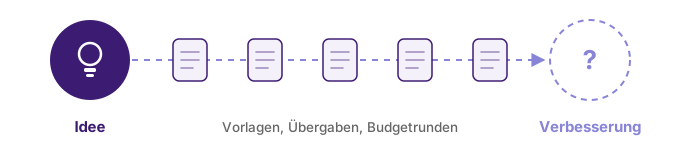
Meanwhile the do-nothing case just keeps running: the team types the same answers as before.
The potential is quite tangible. In a study published in 2025 covering 5,172 customer support agents, agents with AI assistance resolved on average 15% more requests per hour than without it. Whether your own team benefits in a similar way, though, is something you can only find out by trying.
For the first decision, a manageable calculation is therefore enough: What can the test cost? What improvement seems plausible? And what do you want to find out? Uncertain assumptions can stay as ranges, and especially in a business case for an AI project, the range usually tells you more than its midpoint. What you learn from the pilot then makes the calculation more reliable.
During the decision: three projects, three different calculations
Let's say the pilot is convincing. For the rollout, the service assistant now has to win out against other projects, say an AI for sales and automated invoice processing.
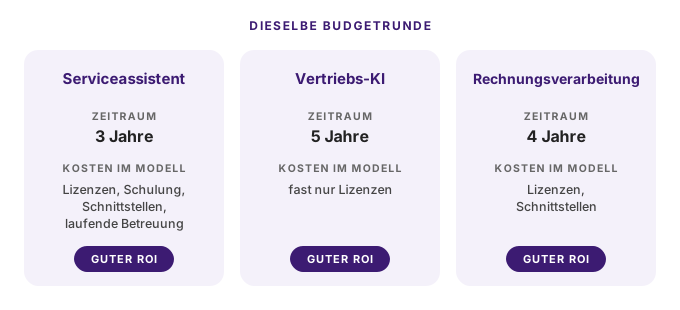
They all promise a good ROI. But one team calculates over three years, another over five; one includes training, interfaces and ongoing support, the next lists almost nothing but license costs. Every calculation lives in its own Excel world.
As a result, the more carefully calculated project can end up looking worse, of all things, and budget and staff may land wherever the assumptions are most optimistic.
This happens especially easily with time savings. If the AI takes an hour of work off someone's plate every day, that's far from meaning payroll goes down. Maybe there's less overtime, maybe the backlog gets smaller or the team can serve more customers. Those are different results, and they belong in the calculation in different ways.
If you want to evaluate innovation projects, you therefore need shared rules for costs, benefits and time horizon. That includes the question of whether the project still pays off if the AI is used less than expected.
After the decision: what did the project actually deliver?
The AI gets introduced, the team trained, the project closed. Six months later the CFO asks what happened to the promised savings.
There are numbers on generated answer suggestions and active users. But so far nobody has pulled together whether requests get resolved faster overall, how much rework there is and what's left after running costs.
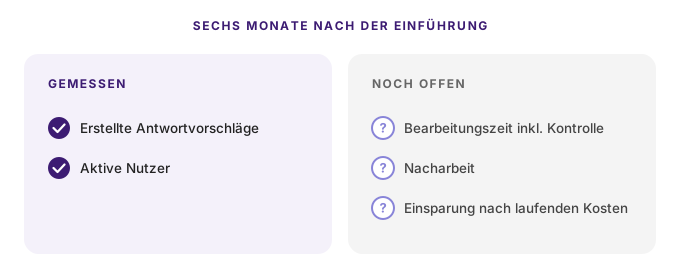
That also means the basis for the next decision is missing: Does it work well enough for more teams, does something need to change, or would the budget be better spent elsewhere?
The targets from the business case should therefore move straight into implementation. For the service assistant, that would be things like handling time including review, answer quality, usage and actual costs, each with an owner and a fixed date to check.
The approved calculation stays in place as the baseline, and actual results flow into an updated forecast. That way you can see what the AI delivers and where it needs fixing.
What does this have to do with Germany's capacity to innovate?
A postponed AI pilot looks small. But when delays like this add up across many companies, productivity gets left on the table: work takes longer than necessary, scarce skilled staff stay tied up with routine tasks and money is missing for more effective projects.
As a managing director, you can act directly at three points:
| Phase | What slows things down | Economic consequence | What helps |
|---|---|---|---|
| Before the decision | High effort before the first test | Ideas sit around, improvements come later | Easy start and a limited test budget |
| During the decision | Different calculation rules | Budget may go to the wrong projects | Comparable business cases with ranges |
| After the decision | Planning and success measurement drift apart | Benefit stays unclear, corrections come late | Derive targets from the model and track results |
So Germany's capacity to innovate also depends on how easily a good idea gets to a first try inside the company, and whether the company then learns enough from it to turn a successful try into a bigger improvement.
Frequently asked questions
- Why do German companies struggle with innovation?
- In its 2026 report, the Expertenkommission Forschung und Innovation names skills shortages, high costs, economic risks and bureaucratic burdens as the central hurdles. On top of that come hurdles inside the company: elaborate business cases before the first test, calculations in the budget round that can't be compared, and no success measurement after rollout. A company can remove these three itself.
- How many mid-sized companies in Germany actually innovate?
- According to the KfW-Innovationsbericht Mittelstand 2025, 41% of companies in the German Mittelstand introduced new or improved products or processes between 2022 and 2024. That is two percentage points more than in the previous survey. So the majority introduced no innovation in that period.
- How do I build a business case for an AI pilot when I don't know the numbers yet?
- For a pilot, a manageable calculation is enough: what the test can cost, what improvement is plausible and what you want to find out. You can state uncertain assumptions as ranges instead of a single number. The results from the pilot then make the calculation more reliable.
- How do I compare several innovation projects fairly?
- All projects need the same rules for costs, benefits and time horizon, otherwise the more carefully calculated project quickly looks worse. You can then distinguish time savings by whether they cut costs, reduce overtime or create extra capacity. Bayescase, innovation management software, calculates business cases with ranges for this and makes them comparable.
- How do I measure whether an innovation project paid off?
- The targets from the approved business case become metrics with an owner and a fixed review date. The approved calculation stays in place as the baseline, and actuals flow into an updated forecast. That shows early on whether the project is delivering or needs to be adjusted.
- How do I see where our own innovation process gets stuck?
- By looking at it phase by phase, from submission through evaluation and decision to goals and tracking, and noting honestly what actually happens today. For a first assessment there is the innovation process check, which goes through the five phases in about three minutes.
Sources
KfW Research: KfW-Innovationsbericht Mittelstand 2025: March 2026. The share of innovators for 2022–2024 is 41%, two percentage points more than for 2021–2023. The definition also includes organizational and marketing innovations. The rate measures innovations actually introduced, not the existence of ideas or ongoing innovation projects.
Expertenkommission Forschung und Innovation (EFI): Gutachten 2026: Report on research, innovation and technological performance in Germany 2026, chapter B1, especially section B1-4. Skills shortages, costs, economic risks and regulatory and administrative burdens are discussed as the central barriers to innovation. The internal approval and steering problems described in this article are our own business assessment; the report does not quantify their contribution.
Erik Brynjolfsson, Danielle Li and Lindsey Raymond: Generative AI at Work: The Quarterly Journal of Economics 140(2), 2025, pp. 889–942. Studies 5,172 customer support agents and reports on average 15% more resolved requests per hour. The result applies to the context studied and is no general promise of staff or cost savings.
