
QUANTIFIED IMPACT
What Product & Portfolio Teams Gain
Shorter portfolio cycles
Cases that already quantify customer problem, financial impact, and portfolio fit need fewer review rounds.
THE PRODUCT & PORTFOLIO REALITY
Where Investment Decisions Break Down
Portfolio reviews stall when value is quantified late, single-point estimates dominate, and risk stays implicit.
Business cases arrive too late
Value is often quantified only after ideas are already politically or emotionally committed.
Single-point estimates dominate
One ROI number suggests certainty, even though adoption, delivery speed, and impact are highly uncertain.
Trade-offs are hard to compare
When every initiative has only the "expected value," ideas look indistinguishable.
Risk is implicit, not explicit
Execution risk, dependency risk, and adoption uncertainty remain qualitative and unranked.
The Result
Flat portfolios, opaque trade-offs, and capital deployed without a clear view of risk and likelihood.
THE PROBLEM
Single-Point Estimates for Probabilistic Bets
Traditional Approach
- Spend days building a single business case per initiative
- Compare projects on averages instead of distributions
- Treat risk qualitatively or late in the process
- Make portfolio trade-offs difficult to justify
Bayescase Approach
- Build a CFO-ready case in under 30 minutes
- Simulate 10,000+ scenarios per initiative
- Show risk in probability distributions and mitigate before committing
- Rank initiatives by upside, downside, and confidence
HOW IT WORKS
How Product Teams Prioritize with Probability
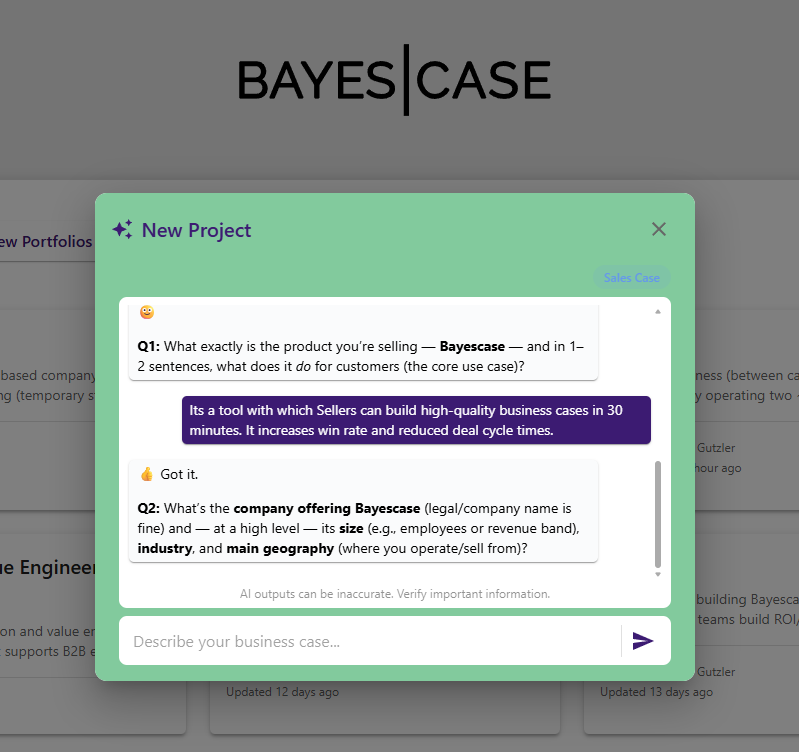
Capture initiative assumptions in a guided flow
Define adoption, delivery effort, impact timing, and operating constraints through a structured interview. Bayescase turns this into a clear assumption baseline for product and portfolio reviews.
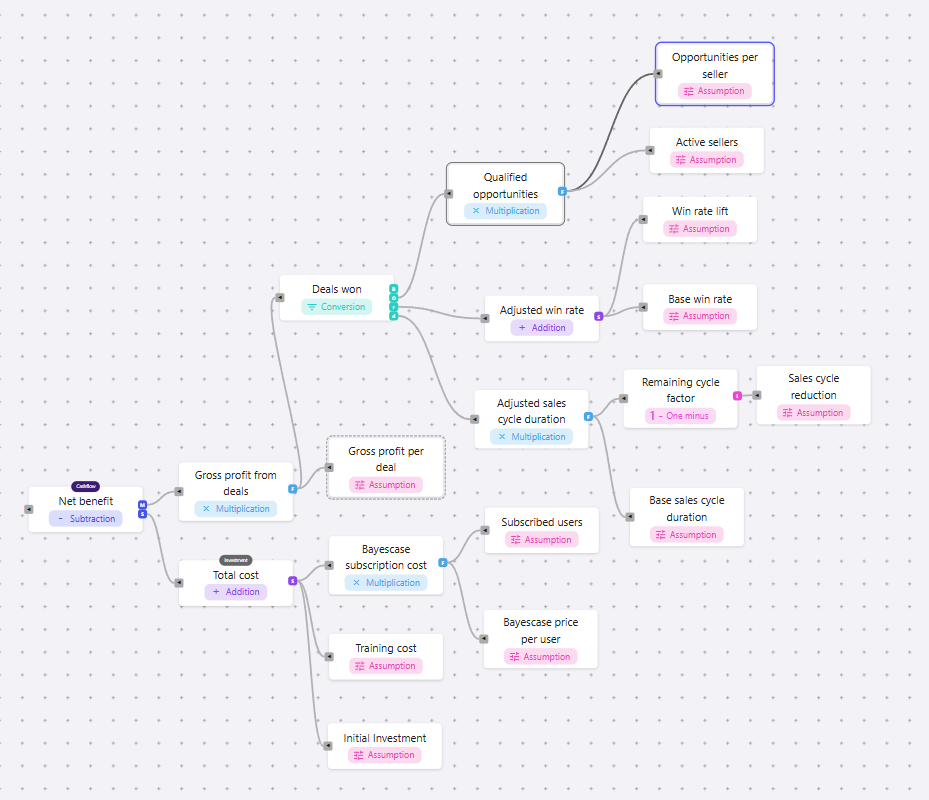
Generate transparent prioritization logic automatically
Bayescase builds initiative logic end-to-end and links every assumption to outcomes. Teams can review dependencies quickly and avoid opaque spreadsheet handoffs.
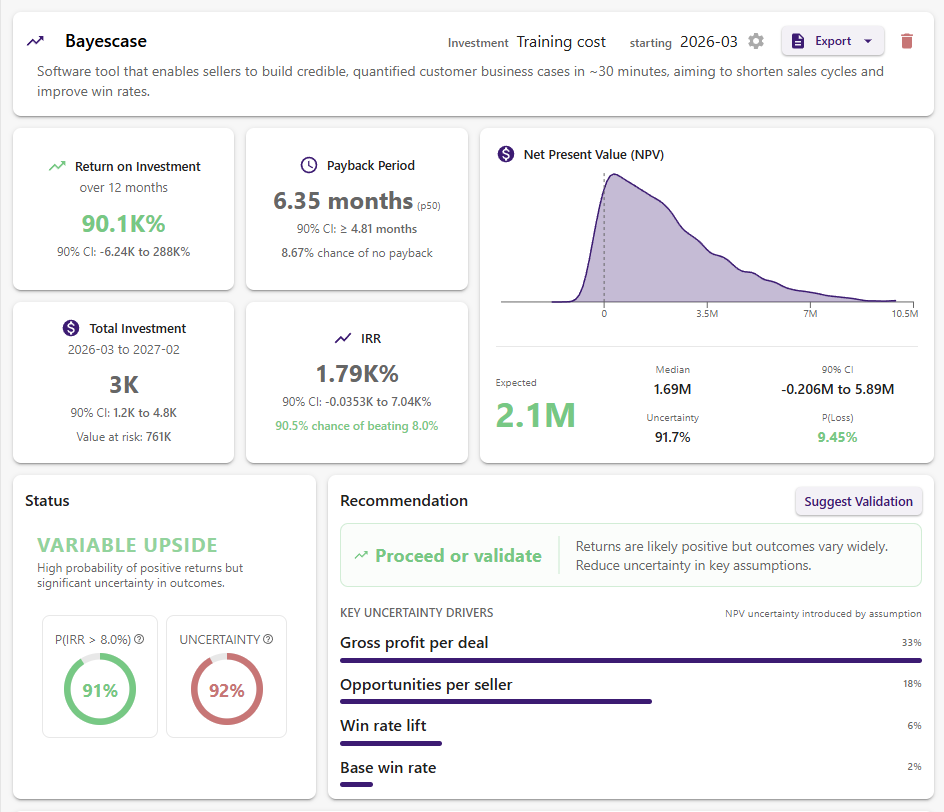
Compare upside, downside, and confidence across initiatives
See expected impact, downside risk, and probability distributions side-by-side. Identify which bets dominate, which are fragile, and where discovery work will improve portfolio confidence most.
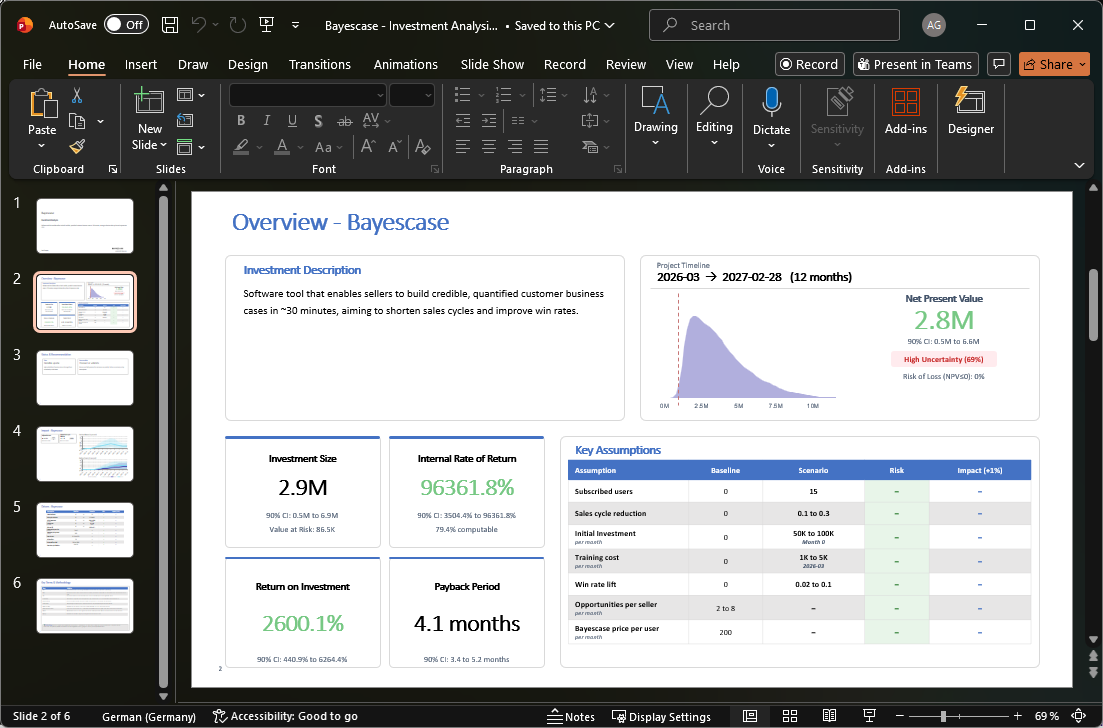
Export stakeholder-ready prioritization narratives
Share roadmap and portfolio decisions with assumptions, scenarios, and risk-adjusted outcomes in one consistent format. Alignment improves because trade-offs stay transparent.
Updates flow from model to narrative without manual rewrites.
THE BAYESCASE ADVANTAGE
Probabilistic Prioritization for Product & Portfolio Teams
Probabilistic prioritization
Compare initiatives by impact and risk rather than single numbers. See which bets truly dominate.
Early value modeling
Build a credible business case in under 30 minutes, even at idea or discovery stage.
Explicit delivery and adoption risk
Understand how execution uncertainty can be mitigated before committing teams.
Clear portfolio trade-offs
See which initiatives drive most upside, where downside risk clusters, and where validation matters most.
Reusable product value drivers
Create a library of validated assumptions across products, markets, and customer segments.
Fits your product stack
Use Bayescase for value modeling, then feed results into roadmap tools, planning decks, or portfolio reviews.
FAQ
QUESTIONS? ANSWERS.
READY TO FUND YOUR BEST PRODUCT INVESTMENTS?
Build a Portfolio-Ready Case in Under 30 Minutes
Give every product team the structure that turns a product idea into an investment the committee can confidently approve.